




Working from a café in Chiang Mai, taking calls by the sea, or ending the day with street food in Bangkok. For many digital nomads in Thailand, that’s everyday life.
Warm weather, an affordable cost of living, good connectivity, and cities set up for remote work have made Thailand one of the most popular destinations for remote work.
In this 2026 guide we’ll walk you through living costs, where to stay, visa considerations, and how to get online from day one.
Why do digital nomads love Thailand?
It brings together a lot of things that are hard to find in one place:
- A lower cost of living than many European cities
In cities like Chiang Mai, you can find modern apartments starting at around €250–400 a month, eat out for very little, and get around by Grab or motorcycle without spending much. - Good internet in the main cities
Bangkok, Chiang Mai, and Phuket offer fast, reliable connections in accommodation, coworking spaces, and cafés. An eSIM also makes it easy to have mobile data as soon as you land. - Coworking spaces and cafés everywhere
Most areas popular with international visitors have work-friendly spaces. Many stay open 24/7 and have a welcoming community. - A large international community
It’s easy to meet other freelancers, creators, entrepreneurs, and remote workers. There are events, groups, networking opportunities, and plenty of ways to socialize. - Warm weather for much of the year
There is a rainy season, but many areas stay warm year-round, which appeals to anyone looking to escape a European winter. - Great food at affordable prices
Eating well in Thailand doesn’t have to cost much. From street food stalls to modern restaurants, there’s something for every budget. - Easy connections to the rest of Asia
From Thailand, you can often find affordable flights to Bali, Vietnam, Japan, Singapore, and Malaysia. Many nomads use this as a chance to explore other countries. - Convenient day-to-day living for international residents
Ride-hailing and delivery apps, laundries, gyms, cafés, apartments with pools or security: many cities make longer stays easy.
You can live well, work comfortably, and keep exploring without spending half your paycheck.
How much does it cost to live in Thailand in 2026?
That depends on the city, your accommodation, and your lifestyle. Bangkok and Chiang Mai don’t cost the same, and neither do eating out every day and cooking at home. Still, Thailand is an appealing option for remote work on a reasonable budget.
With a little planning, you can live comfortably for less than in many European cities.
Chiang Mai: the budget-friendly option
For years, Chiang Mai has been one of the world’s digital nomad hubs. It’s peaceful, easy to work from, and considerably cheaper than Bangkok or the islands.
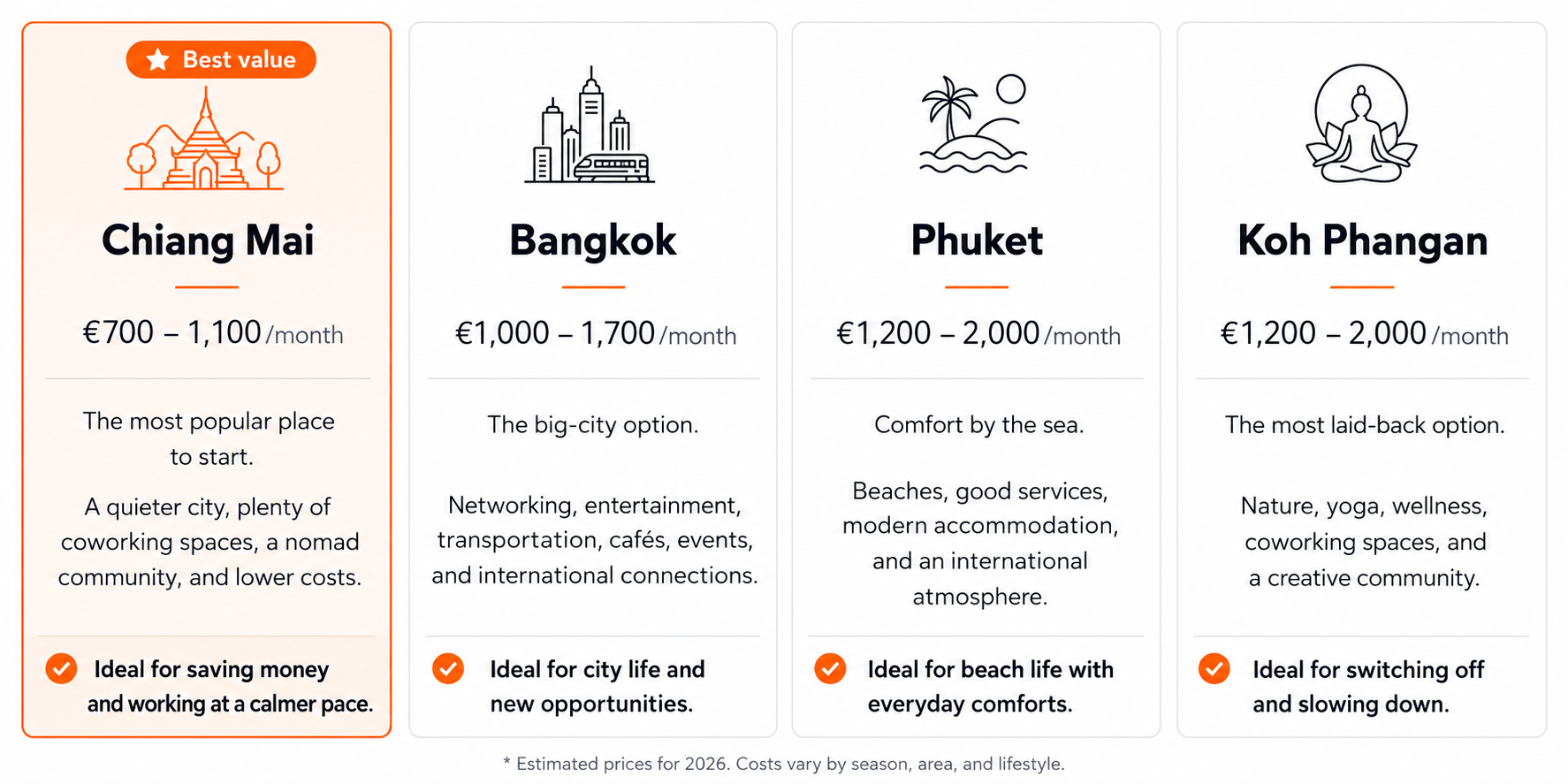
A budget of around €700–1,100 a month can cover a comfortable lifestyle, including:
- A furnished apartment
- Everyday meals
- Transportation
- Cafés or coworking spaces
- A gym membership and everyday essentials
The city is well set up for remote work, with cafés offering good Wi-Fi, plenty of coworking spaces, and a large international community.
It’s a great choice if you want to focus on work, save a little more, and enjoy a quieter routine with a good quality of life.

Bangkok: big-city energy and more options
If Chiang Mai is laid-back, Bangkok is full of energy. Thailand’s capital brings together skyscrapers, 24-hour cafés, modern coworking spaces, nightlife, and endless choices for food and entertainment.
It’s also a great place in Southeast Asia for networking, events, meeting other entrepreneurs, and moving between meetings and workspaces. Just allow for a slightly higher budget.
A comfortable lifestyle in Bangkok usually calls for around €1,000–1,700 a month, depending mainly on the neighborhood, your accommodation, and your lifestyle.
Popular neighborhoods with digital nomads include:
- Sukhumvit, for its international atmosphere, transportation links, and cafés
- Ari, for a quieter, modern feel
- Silom, for a lively urban area with good connections
Transportation works well for such a big city, and internet connections are generally reliable in both apartments and coworking spaces.
A good fit if you want a lively city, plenty of choice, and an active social life.

The islands: work with a sea view
Koh Phangan, Phuket, and Koh Samui offer the beachside version of remote work in Thailand: work near the sea, finish the day with a sunset, and settle into a slower pace.
Alongside beautiful beaches, many islands now have established international communities, work-friendly cafés, gyms, wellness spaces, and coworking options for longer stays. Island life usually costs more than Chiang Mai, especially in peak season or busy tourist areas.
For a comfortable lifestyle, a typical budget is around €1,200–2,000 a month, depending mainly on:
- The island you choose
- How close you are to the beach
- Your accommodation
- Your lifestyle
Phuket tends to offer the widest range of services and a more urban feel. Koh Samui combines convenience with an international atmosphere, while Koh Phangan attracts creatives and people interested in wellness or online business.
In more remote areas, connection quality can vary a lot between properties. Check the Wi-Fi before committing to a place, or arrange an eSIM with a suitable data plan before settling in.
Ideal if you want to work remotely while enjoying the sea, warm weather, and a slower routine.

Cost of living in Thailand by city
Estimated monthly living costs in Thailand
Internet in Thailand: is it reliable?
Yes. In Bangkok, Chiang Mai, and most tourist areas, internet generally works well in accommodation, cafés, and coworking spaces.
If you work online, though, relying only on your hotel or apartment Wi-Fi can be risky. Speeds can drop, the connection can fail just before a meeting, or coverage may not reach every room. That’s why many digital nomads use Wi-Fi with mobile data as a backup.
It’s often easiest to arrive with a Thailand eSIM already installed and your data connection ready to use.
- Book a Grab ride as soon as you land
- Find your accommodation without hunting for Wi-Fi
- Share your mobile connection if the Wi-Fi drops
- Have a backup for meetings and work
- Stay connected while moving between cities or islands
Working from cafés, moving around, and taking short trips are all part of life for many nomads in Thailand. Reliable mobile data soon becomes more useful than you might expect.
Because when your internet goes down, your office does too.
Visas for living in Thailand in 2026
Entry rules and visa options can change. Always check official information before booking flights or planning a longer stay. Common options to look into include:
- Short tourist stays
- Possible extensions within the country
- Long-stay visas based on your professional or financial circumstances
- Programs for remote workers or longer stays
Before traveling, make sure you review the latest entry requirements. You can check the documents and requirements for traveling to Thailand here to avoid surprises before departure.
Now for the part you rarely see on Instagram. Nomad life in Thailand has a lot going for it, but there are challenges too: humidity, the time difference with Europe, unreliable Wi-Fi, or trying to focus when there’s a beach nearby.
For many people, the trade-off is well worth it.
Working remotely from Thailand can mean more freedom, a lower budget than in many European cities, and a completely different daily routine, with a sea view as a bonus.
A reliable connection from day one makes a real difference. You can explore our Thailand eSIM here and arrive ready to get online, without relying on your home plan’s roaming or airport Wi-Fi.