



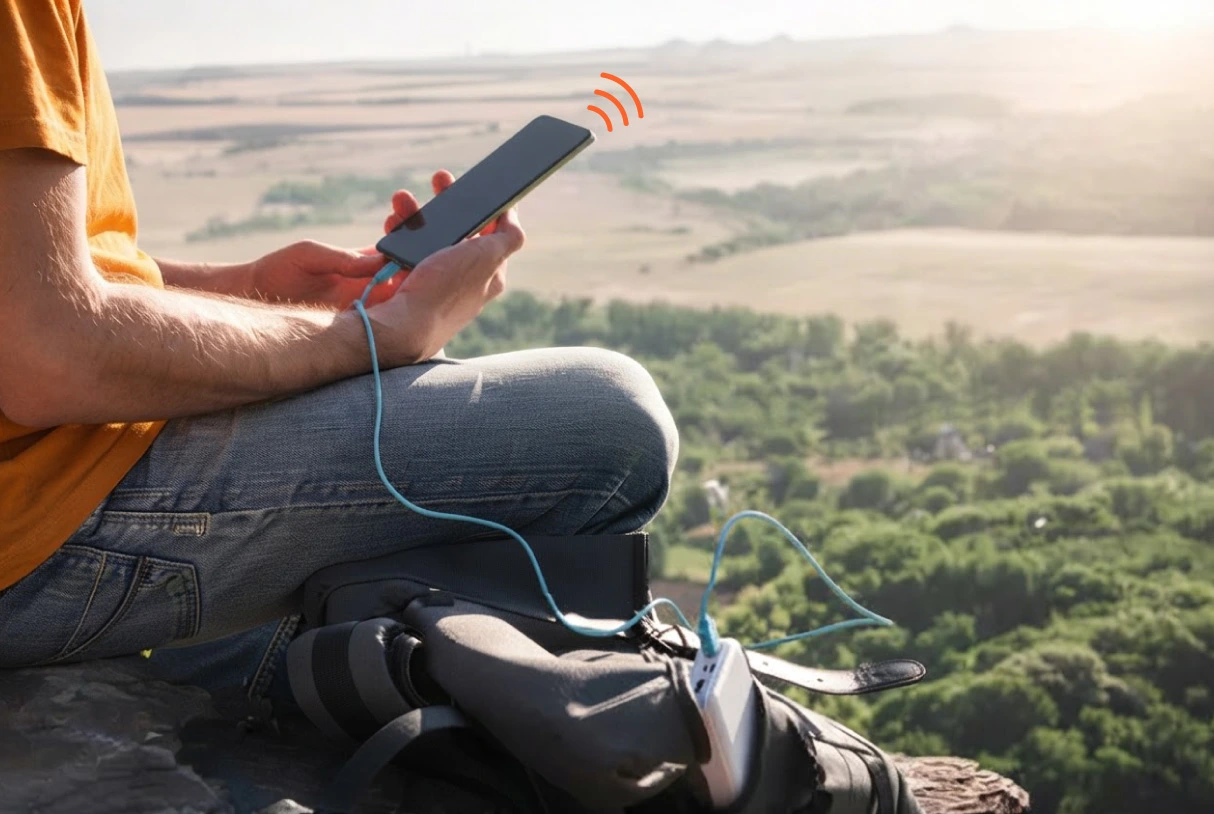
Taking a power bank so your phone lasts throughout your trip? Before you put it in your backpack, there’s more to check than whether it’s charged: where it needs to travel, its capacity, and whether your airline lets you use it on board.
Yes, you can bring a power bank on a plane if it meets your flight’s requirements, but it must travel in the cabin, never in checked baggage. Being allowed to bring it doesn’t mean you can connect it to your phone during the flight.
1. Your power bank stays with you in the cabin
Keep it somewhere accessible in your carry-on bag. If you’re asked to check your bag at the gate, take the power bank out before handing it over: when your bag moves to the hold, what you can leave inside changes too.
Protect the battery against impacts and short circuits with a case or its packaging, and keep the terminals protected. Don’t leave it loose alongside keys or coins. If it’s swollen, damaged, or getting unusually hot, don’t take it on your trip. These recommendations come from IATA’s guidance on traveling with lithium batteries.
A wall charger without an internal battery is a different item: it doesn’t store energy like a power bank. This article covers portable batteries you use to charge your phone or other devices.
2. Check the Wh, not just the mAh
The figure you need is the energy capacity expressed in watt-hours (Wh). If it’s printed on the battery, use that figure. If only milliamp-hours (mAh) are listed, you’ll also need the nominal voltage associated with that capacity.
Wh = (mAh ÷ 1,000) × nominal voltage. Don’t automatically use the USB output voltage: the voltage must correspond to the capacity you’re converting. The guide to electronic devices from Iberia explains how to read these figures.
| Example label | Calculation | Result |
|---|---|---|
| 10,000 mAh at 3.7 V | 10 × 3.7 | 37 Wh |
| 20,000 mAh at 3.7 V | 20 × 3.7 | 74 Wh |
| 30,000 mAh at 3.7 V | 30 × 3.7 | 111 Wh |
These are calculation examples, not permission to fly. Don’t assess two models with the same advertised mAh rating without checking their labels. If the capacity can’t be verified, the airline may refuse to carry the device; check with the manufacturer and airline before you go.
How to read a label without confusing capacity and fast charging:
SAMPLE LABEL · for illustration only
Battery capacity: 20,000 mAh · 3.7 V · 74 Wh
These figures describe the nominal capacity. To compare it with the flight limit, start with 74 Wh.
USB-C output: 5 V / 3 A · 9 V / 2.22 A · Max 20 W
This describes the charging output. The 20 W refers to power, not stored energy: it doesn’t mean 20 Wh.
Check: 20,000 ÷ 1,000 × 3.7 = 74 Wh. Don’t multiply those 20,000 mAh by the 9 V USB output.
If the nominal voltage is missing or the figures don’t add up, look up the model’s specifications or contact the manufacturer. Don’t guess an equivalent value or make your own label: the calculation helps you understand the capacity, but it doesn’t replace verifiable battery identification.
3. Up to 100 Wh or up to 160 Wh? What to do in each case
Up to 100 Wh: check how many you can bring, where to keep them, and whether you can use them. Being below the capacity limit doesn’t settle those other requirements.
Over 100 Wh: the four airlines compared below don’t allow that power bank. For another airline, get specific confirmation before bringing it; don’t read “up to 160 Wh with approval” in a spare battery chart as permission to carry your portable charger.
There’s a reason for the confusion. The IATA guidance on the March 2026 changes distinguishes the ICAO framework, which allows 100–160 Wh power banks with approval, from IATA’s stricter guidance anticipating the 100 Wh limit for 2027. The 2026 passenger guide already reflects that stricter approach. What matters is whether your airline accepts it on that flight.
It’s also worth distinguishing a ban from a recommendation. The March change limits power banks to two per person and prohibits recharging the power bank itself on board; it recommends not using it to power other devices. An airline can turn that recommendation into a ban on its flights. That’s why the table below separates carrying and using a power bank.
4. Iberia, Vueling, Ryanair, and Emirates: carrying and using power banks
Policies checked on October 29, 2026. Every airline in this table requires power banks to travel in the cabin. The maximum number is per passenger, and the capacity limit is per device.
| Airline and official source | Number and capacity | Can it charge your phone? | Where to keep it |
|---|---|---|---|
| Iberia | 2; up to 100 Wh each | Not during the flight | Outside the overhead bins; follow the crew’s instructions |
| Vueling | 2; up to 100 Wh each | Not during the flight; recharging the power bank is also prohibited | Somewhere visible, never in the overhead bins |
| Ryanair | 2; up to 100 Wh each | Yes, except during taxiing, takeoff, landing, or when the crew instructs otherwise; recharging the power bank is prohibited | On your person or in the bag under the seat in front of you; never overhead |
| Emirates | 1; up to 100 Wh under its dangerous goods policy | No; recharging the power bank is also prohibited | In the seat pocket or a bag under the seat in front of you; never overhead |
If you’re flying with two airlines, pack to meet both sets of rules. For example, two power banks may be allowed on your Vueling flight but not on your Emirates flight. Check who operates each flight, not just the brand shown when you buy the ticket.
The most useful question for customer service is a specific one: “I’m flying on [route and date] with a [brand, model, and Wh] power bank, and I’m bringing [quantity]. Is it allowed, where should I keep it, and can I use it?” Attach a photo of the label and keep the reply. The table is a guide; the policy that applies to your booking may change.
5. Being allowed to bring it doesn’t mean you can use it
Charging your phone from a power bank and recharging the power bank from the plane’s outlet are two different things. Check both. Don’t plan your battery life for the whole flight on the assumption that either will be allowed.
If you need to charge your phone, ask the crew which options are permitted on the plane. If a device gets very hot or gives off smoke, alert them immediately and follow their instructions. If it falls into the seat mechanism, don’t move the seat to try to retrieve it.
To help your battery last until you arrive, prepare what you’ll use along the way: downloaded entertainment, your accommodation address, and easy access to your bookings. Our guide to Google Maps offline helps you save maps for those moments without internet.
Questions that come up when you’re packing
If your power bank is right in front of you and you’re still wondering whether you can put it in your backpack, these answers cover the most common situations.
Can I bring a 20,000 mAh power bank?
If its nominal voltage is 3.7 V, that works out to 74 Wh. That’s below 100 Wh, but check the label, the device’s condition, and your airline’s rules.
What about a 30,000 mAh power bank?
At 3.7 V, that would be 111 Wh. Don’t pack it as though it were the same as a smaller model: it may not be allowed. Get explicit confirmation before you travel.
Are the rules different for a magnetic power bank?
It’s still a power bank. Check its capacity and make sure it can’t switch on or start charging your phone inside your bag.
Can I rely on what was allowed on my last trip?
Check the current requirements for every leg of your trip. The airline, route, or rules may have changed.
Before you zip up your bag, take care of the essentials: check your power bank’s label, review the rules for each flight, and decide where you’ll keep it. That way, you won’t be working it all out at the gate. And while you’re thinking about your arrival, check what your mobile plan includes at your destination. If you need data, you can find your eSIM on TurTrip based on how long you’re traveling and how you’ll use it.
And how much data will you need when you land?
Maps, messages, photos… How you use your phone matters when planning your trip, too. Find out which apps use the most data and how to estimate the GB you’ll need.
How many GB do I need for my trip?Sources consulted: IATA: battery safety, IATA’s 2026 passenger guide, IATA guidance on the March 2026 changes and policies from Iberia and Emirates. Policies may change; check the official pages before you travel. The specific policies of the following airlines were also checked: Vueling and Ryanair.